
Why Is Your IELTS Writing Score Stuck at Band 6?
Perhaps you use make an effort incorrectly, repeat the same idea instead of explaining it, leave part of the question unanswered, or make the same grammar mistakes every time you write.
These problems are easy to overlook because your essay may still be understandable and relevant to the topic. But if you want to reach Band 7, you need to identify exactly what’s limiting your score and work on it.
Let’s look at five specific problems, with examples of what they look like in real IELTS writing and practical ways to fix them.
1. You know vocabulary, but you don’t use it precisely
One problem worth investigating is not how many words you know, but how accurately you use them. Imagine you’re writing about the advantages of public transport and write:
Public transport can make traffic less.
The meaning is understandable, but the expression is unnatural. A more natural version is:
Public transport can reduce traffic congestion.
Now consider this sentence:
Governments should do more efforts to protect the environment.
The problem isn’t that you need a more advanced word. The problem is the collocation: we say make an effort, not do an effort.
A better sentence would be:
Governments should make greater efforts to protect the environment.
These mistakes matter because Band 7 requires more than a wide vocabulary. You need to use words and collocations with reasonable precision.
What to do: Take your last three essays and highlight every phrase where you’re unsure about the word choice, collocation, spelling or word form. Don’t simply replace familiar words with complicated synonyms. Check how the expression is actually used, write down the correct phrase, and create two new sentences with it.
For example, learn reduce traffic congestion as a complete expression rather than memorizing congestion on its own. Your goal is to reduce repeated errors and build a collection of expressions you can use accurately under exam conditions. To build your vocabulary and avoid repeating these mistakes, explore the IELTS TIME Vocabulary Bank to learn useful collocations, and use the IELTS Mistake Trainer to practise identifying and correcting common errors.
2. Your ideas are relevant, but you don’t explain them enough
Consider this IELTS Writing Task 2 question:
Some people believe that governments should invest more money in public transport rather than building new roads. To what extent do you agree or disagree?
A student writes:
I believe governments should invest more money in public transport because it is better for the environment. Public transport produces less pollution and helps protect nature.
The student has given a relevant reason, but the explanation largely repeats the same idea. Why does public transport help the environment? Under what circumstances might it make a difference?
Here is a more developed version:
I believe governments should invest more money in public transport because it can reduce the number of private cars on the road. If buses and trains are affordable, reliable and frequent, more commuters may choose to leave their cars at home. This would reduce the number of vehicles producing emissions, particularly in busy city centres.
Notice the difference. The second version explains a chain of cause and effect: better public transport can encourage people to use fewer private cars, which can reduce vehicle emissions. You don’t need to add five ideas to your paragraph. You need to explain one relevant idea clearly enough for the reader to understand your reasoning.
What to do: After writing a main idea, ask yourself two questions: Why is this true? And how does it lead to the result I’m claiming? Add the explanation before moving to your next point. You can use an example if it genuinely helps explain your reasoning, but don’t add an example simply to make the paragraph longer.
3. Your essay answers the topic, but not every part of the question
This is a problem students sometimes overlook because their essays seem relevant.
Look at this question:
Some people believe university education should be free for everyone, while others think students should pay for their own studies. Discuss both views and give your own opinion.
There are three requirements: explain the view that university should be free, explain the view that students should pay, and give your own opinion. A student might write two paragraphs explaining both sides and finish with:
In conclusion, both views have advantages and disadvantages.
This conclusion doesn’t clearly state the student’s own position. Even if the rest of the essay is well written, this is a weakness in responding fully to the task. Another student might give a clear opinion in the introduction but spend the entire essay explaining why university should be free. The second view receives little or no attention.
What to do: Before writing, turn the question into a short checklist. For this example, it could be:
Explain why some people support free university education.
Explain why others believe students should pay.
State which position I support and why.
After writing, check the essay against the list. Don’t just ask, Have I written about the topic? Ask, Have I answered every part of the actual question?
For an agree-or-disagree essay, make sure your position is clear and consistent. For a problem-and-solution essay, explain the problems and provide solutions that address them. The exact requirements depend on the question.
4. Your grammar mistakes keep appearing in the same places
You might be able to write complex sentences, but that doesn’t mean you control them accurately.
For example:
People who lives in big cities often faces a lot of problems.
There are two subject–verb agreement errors. A corrected version is:
People who live in big cities often face a lot of problems.
Or consider:
Although public transport is convenient, but many people still prefer driving.
You don’t need both although and but in this structure. You could write:
Although public transport is convenient, many people still prefer driving.
Or:
Public transport is convenient, but many people still prefer driving.
If the same mistakes appear in essay after essay, writing more essays without targeting those errors may not solve the problem.
What to do: Create a personal error list from your corrected essays. Record the original mistake, the corrected sentence, and the rule you need to remember. Group recurring problems under headings such as articles, subject–verb agreement, verb forms, sentence structure and punctuation.
Then practise the specific pattern. If you repeatedly write people lives, don’t study every grammar topic in English. Write ten new sentences using plural subjects correctly, then check your next essay specifically for that error.
You don’t need to eliminate every mistake to reach Band 7. However, you do need a good level of grammatical control, including the ability to use a range of sentence structures accurately.
5. Your paragraphs contain linking words, but the ideas don’t flow logically
Many students believe that good coherence means using expressions such as Firstly, Moreover, Furthermore and On the other hand. But linking words cannot create a logical connection that isn’t there. Consider this paragraph:
Public transport should receive more government funding. Moreover, many people prefer living in cities. Furthermore, pollution is a serious problem. Therefore, governments should improve bus services.
The paragraph contains several linking expressions, but the relationship between the ideas is not fully explained. Why does the fact that many people prefer city life lead to better bus services?
A clearer version would be:
Public transport should receive more government funding because it can help cities manage growing traffic levels. As urban populations increase, more people need to travel to work and access essential services. If bus services are frequent and reliable, some commuters may choose public transport instead of driving, helping to ease congestion.
Here, each sentence develops the same central argument. The connections are clear even without a linking word at the beginning of every sentence.
What to do: Read each body paragraph and underline its main idea. Then ask whether every other sentence explains, supports, or illustrates that idea. If a sentence introduces a different argument, either connect it logically or move it to another paragraph. Use linking words when they clarify a relationship, not simply because you think every sentence needs one.
How do you find out which problem is holding you back?
Don’t try to fix all five problems at once. Start with your last two or three essays and look for repeated patterns.
If you frequently use unnatural expressions, work on collocations and word choice. If your paragraphs contain claims without explanations, practise developing ideas. If you miss parts of the question, spend more time analysing the task before writing. If the same grammar mistakes keep appearing, build a targeted practice routine around them.
One important point: these are common reasons students struggle to move beyond Band 6, not a diagnosis of your individual writing. IELTS Writing is assessed using four criteria — Task Achievement or Task Response, Coherence and Cohesion, Lexical Resource, and Grammatical Range and Accuracy. A weakness in one area can affect your overall performance, but you need to examine actual writing to identify which problems matter most for you. The aim isn’t to write more complicated essays. It’s to write clearer, more accurate and better-developed ones.
If you’re unsure what to work on next, start by identifying your weaknesses. You can try our IELTS Writing Task 1 assessment, Writing Task 2 assessment and Speaking assessment to help you decide which areas need more attention.
If you need more personalised guidance, you can also request a 1-to-1 Strategy Session with IELTS TIME. We can look at your current level, the problems you’re experiencing, and what you should prioritise before spending more time practising the wrong things.
Talk soon,
Iman
About the author

Teacher Iman
IELTS Specialist & Founder of IELTS TIME
- CELTA
- DELTA
- MA in English Language Teaching
- 15+ Years IELTS Teaching Experience
Not sure what is stopping your IELTS progress?
Take the free IELTS assessment and get your personal roadmap.
Related Articles
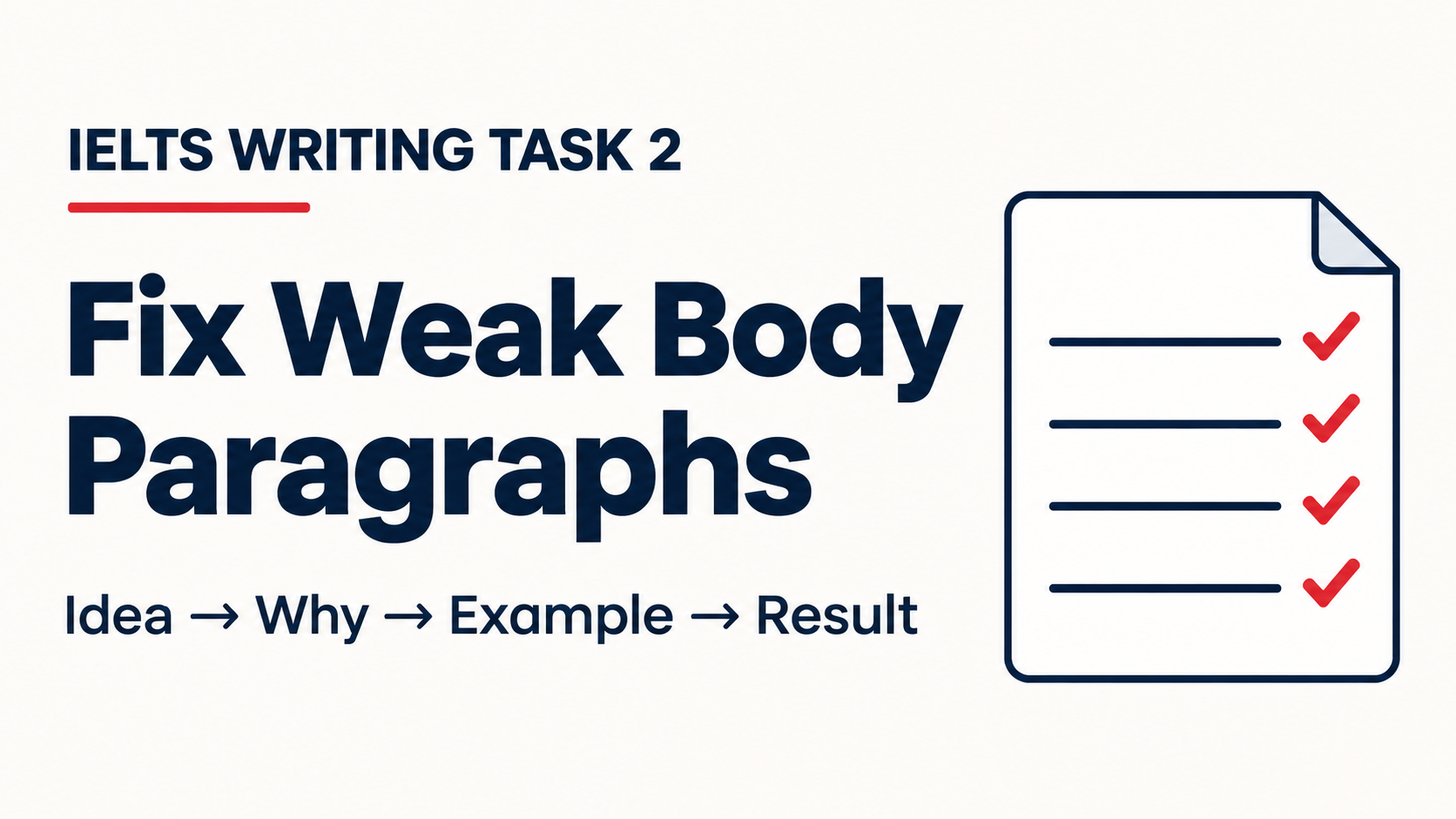
How to Fix Weak Body Paragraphs in IELTS Writing Task 2
Your IELTS body paragraph has three relevant ideas, but each gets only one sentence. By the end, the reader knows what you think but has little idea why. In my video, I use a question about whether the advantages of learning a foreign language in primary school outweigh the disadvantages...

Do You Need Expert Knowledge for IELTS Writing Task 2?
An IELTS essay question may ask about education, technology, work, or the environment. You might look at the topic and think: “I don’t know enough about this.” You don’t need expert knowledge. You need to answer the question with relevant ideas and explain them clearly. These practice examples show how to do that.
How Many Words Should You Write in IELTS Writing Task 2?
250 words is the minimum for IELTS Writing Task 2. But word count is only one part of your answer. You also need to answer the question, explain your ideas, and organize them clearly. My practical suggestion is to aim for around 260–270 words, then leave time to check your work.
Questions & Comments
Have an IELTS question about this? Ask below — comments are reviewed before they appear.
No comments yet — be the first to ask a question.