
Do You Need Expert Knowledge for IELTS Writing Task 2?
An IELTS essay question may ask about education, technology, work, or the environment. You might look at the topic and think: “I don’t know enough about this.”
You don’t need expert knowledge. You need to answer the question with relevant ideas and explain them clearly.
These practice examples show how to do that.
Start with an idea you understand
Imagine you are discussing the advantages of working from home.
A simple point is:
“Working from home saves time.”
You don’t need a more impressive idea. You need to explain this one.
Ask: How does it save time?
“Employees do not need to travel to an office.”
Then ask: Why is that useful?
“They can use that time to prepare meals, exercise, or spend time with their families.”
Your developed point becomes:
“Working from home saves time because employees do not need to travel to an office. They can use that time to prepare meals, exercise, or spend time with their families.”
The explanation makes the point useful—not difficult words.
Choose ideas you can explain
Suppose the question is about online university courses.
You might think of several advantages:
lower costs;
flexible study hours;
access for students who live far from a university.
Choose the ideas that fit your answer and that you can explain confidently.
For example:
“Online courses can reduce living costs because students may be able to stay at home instead of renting accommodation near the university.”
This explains which costs students can avoid and how online study helps.
However, check your claim carefully. Not all online courses are cheaper, and not all students can study from home. Words such as “can” and “may” help you avoid making claims that are too broad.
You don’t need invented studies or statistics
Avoid sentences such as:
“According to a famous university, 90% of students learn better online.”
A made-up statistic does not develop your argument. Explain a realistic situation instead:
“Students with full-time jobs may find recorded lessons useful because they can watch them after work.”
The reader can understand who benefits and why.
Keep your explanation connected to the question
A clear explanation still needs to support your argument.
If the question asks whether the advantages of working from home outweigh the disadvantages, don’t simply describe someone’s daily routine. Show why the benefit or problem matters.
For example:
“Working from home can make communication harder because employees cannot always ask a colleague a quick question in person. If they have to wait for an online reply, their work may be delayed.”
The final sentence explains the effect of the problem.
Try this five-minute exercise tonight
Develop this sentence:
“Online courses can make education more accessible.”
Before writing, answer three questions:
Who might find it difficult to attend a university?
How could online courses help?
Why would that make a difference?
One possible answer is:
“Online courses can make education more accessible to people who live far from a university. They can attend lessons from home without moving to another city, making it easier to study while continuing their local jobs.”
Now try the same process with one point from your own essay.
Check your paragraph before adding another idea
Ask yourself:
Does this point answer the question?
Have I explained how or why?
Does my example support the point?
Have I made a claim that is too broad?
If the explanation is missing, develop the point you already have before adding another one.
See how this works in a real student essay
In my IELTS Writing Clinic lesson, we keep a student’s main ideas and improve their explanations, sentence connections, and grammar.
About the author

Teacher Iman
IELTS Specialist & Founder of IELTS TIME
- CELTA
- DELTA
- MA in English Language Teaching
- 15+ Years IELTS Teaching Experience
Not sure what is stopping your IELTS progress?
Take the free IELTS assessment and get your personal roadmap.
Related Articles
How to Fix Weak Body Paragraphs in IELTS Writing Task 2
Your IELTS body paragraph has three relevant ideas, but each gets only one sentence. By the end, the reader knows what you think but has little idea why. In my video, I use a question about whether the advantages of learning a foreign language in primary school outweigh the disadvantages...
How Many Words Should You Write in IELTS Writing Task 2?
250 words is the minimum for IELTS Writing Task 2. But word count is only one part of your answer. You also need to answer the question, explain your ideas, and organize them clearly. My practical suggestion is to aim for around 260–270 words, then leave time to check your work.
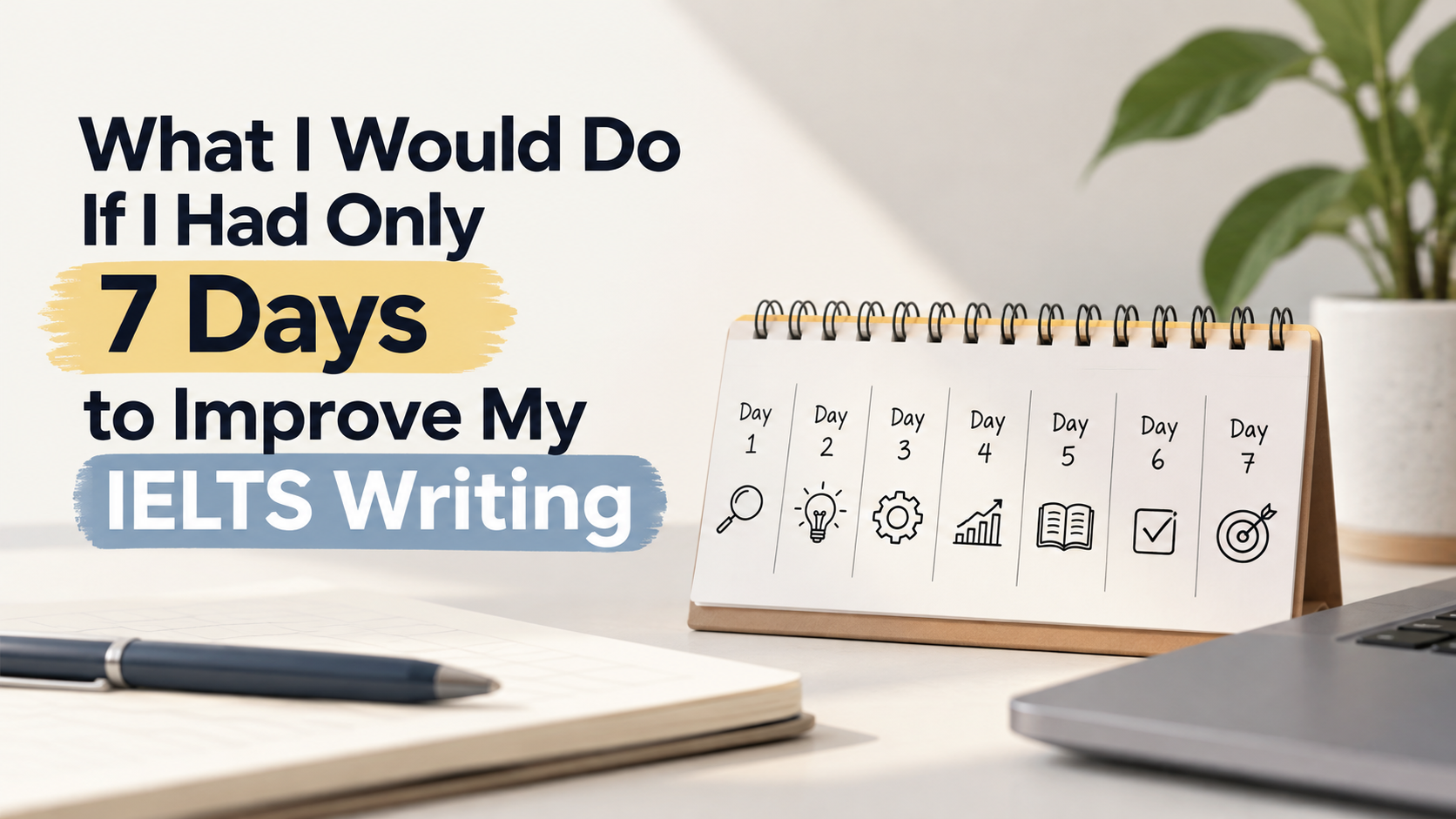
What I Would Do If I Had Only 7 Days to Improve My IELTS Writing
Imagine my IELTS test is in seven days. My Writing score is stuck at Band 6, but I need Band 7. I wouldn't waste time memorizing advanced vocabulary or writing endless essays. Instead, I would focus on the mistakes that are costing me marks and practice correcting them. Here’s exactly what I would do.
Questions & Comments
Have an IELTS question about this? Ask below — comments are reviewed before they appear.
No comments yet — be the first to ask a question.