
What I Would Do If I Had Only 7 Days to Improve My IELTS Writing
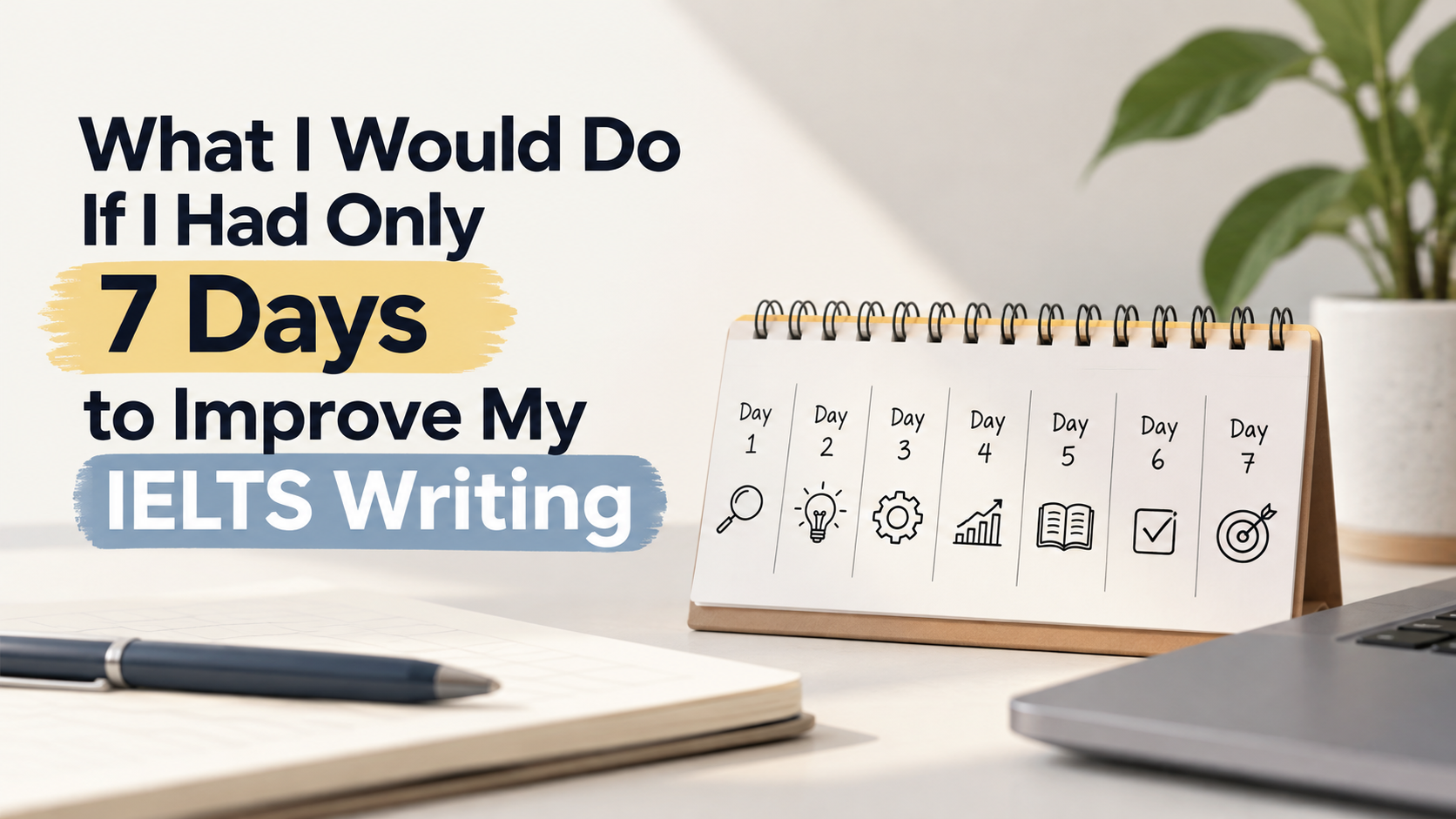
Day 1: Find out what’s wrong with my writing
I would complete one Task 1 and one Task 2 under exam conditions: 20 minutes for Task 1 and 40 minutes for Task 2. Then I would get feedback from a qualified teacher, ideally using the official IELTS assessment criteria. I would want to know exactly what is holding my score back. Is it grammar? Poorly developed ideas? Inaccurate vocabulary? Missing key features in Task 1?
For example, if my teacher highlighted this sentence:
Technology is good for education because it helps students learn better.
I would know that my explanation needs work. But if my main problem were grammar, I wouldn’t spend the next three days practicing idea development.
My goal: Identify my two or three biggest weaknesses and prioritize them for the rest of the week.
Day 2: Practice developing Task 2 ideas
I would choose three Task 2 questions and practice writing body paragraphs rather than complete essays.
For example:
Some people believe that working from home is better than working in an office. To what extent do you agree or disagree?
My initial idea might be:
Working from home improves work-life balance.
I would develop it by asking why, how, and what is the result?
Working from home can improve employees’ work-life balance because they no longer need to spend hours commuting. As a result, they have more time to spend with their families or pursue personal interests.
I would do the same with five more ideas, checking whether each explanation directly supports the main point.
My goal: Write six well-developed body paragraphs without unnecessary repetition.
Day 3: Fix my recurring grammar mistakes
I wouldn’t try to learn advanced grammar in one day. I would collect ten mistakes from my previous essays and practice correcting them.
For example:
Incorrect: The number of students have increased.
Correct: The number of students has increased.
Then I would write another sentence using the same structure:
The number of people working remotely has increased.
Or:
Incorrect: Governments should invest on education.
Correct: Governments should invest in education.
New sentence: Governments should invest in public transportation.
My goal: Correct ten recurring mistakes and write two new sentences for each corrected structure.
Day 4: Improve Task 1
For Academic IELTS, I would practice introductions, overviews, and selecting key features. I would choose three charts and write an introduction and overview for each.
For example, imagine a line graph showing that the number of international students increased in three countries between 2000 and 2020, with Canada experiencing the largest increase.
My overview could be:
Overall, the number of international students increased in all three countries, with Canada experiencing the most significant growth.
I would then practice grouping information and making comparisons rather than describing every figure separately. For General Training, I would practice writing letters, making sure I addressed all three bullet points and used an appropriate tone.
My goal: Complete three introduction-and-overview exercises and one full Task 1 response.
Day 5: Improve vocabulary accuracy
I wouldn’t memorize 50 advanced words. I would focus on useful collocations and expressions for common IELTS topics. For example:
Instead of:
The government should make more jobs.
I would write:
The government should create more job opportunities.
Instead of:
Students can get more knowledge.
I might write:
Students can acquire knowledge through practical experience.
I would choose four common topics, such as education, employment, technology, and the environment, and learn three useful collocations for each. Then I would write my own sentences using them.
My goal: Learn and correctly use 12 useful collocations, not simply memorize their meanings.
Day 6: Take another full Writing test
I would complete another Task 1 and Task 2 under timed conditions. Then I would compare my writing with Day 1. For example, if I had previously struggled to develop ideas, I would examine whether my new body paragraphs contained clearer explanations.
If grammar was my main weakness, I would count how often I repeated the mistakes from Day 3. I would also check whether I finished both tasks on time and had a few minutes left to review my answers.
My goal: Find evidence of improvement and identify any problems that still need attention.
Day 7: Review and prepare for test day
I wouldn’t write another full essay unless there was a clear reason to do so. Instead, I would review my corrected mistakes and practice planning three Task 2 essays.
For each question, I would spend five minutes identifying what the question requires, deciding my position if necessary, and choosing two ideas I could explain confidently. I would also review my Task 1 overview practice and my personal grammar error list.
My goal: Go into the test knowing which mistakes to watch for and how to approach both tasks.
Would seven days really make a difference?
Possibly, but it depends on why your score is low.
If you have serious difficulties with English grammar or vocabulary, seven days won’t be enough to overcome them. However, if you’re already close to your target band and your problems involve underdeveloped ideas, poor organization, or repeated mistakes, focused practice could help.
The important thing is that I wouldn’t measure my progress by how many essays I wrote. I would measure it by how many mistakes I stopped repeating. That’s how I would use my final seven days.
If you’re preparing for IELTS Writing, you can also use my free Task 2 Planner to practice organizing opinion essays and the Task 1 Paraphraser to improve your introductions. And if you’re stuck at Band 6 or 6.5 and need help identifying your weaknesses, you can book a 1-to-1 Session with me.
Talk soon,
Iman
About the author

Teacher Iman
IELTS Specialist & Founder of IELTS TIME
- CELTA
- DELTA
- MA in English Language Teaching
- 15+ Years IELTS Teaching Experience
Not sure what is stopping your IELTS progress?
Take the free IELTS assessment and get your personal roadmap.
Related Articles
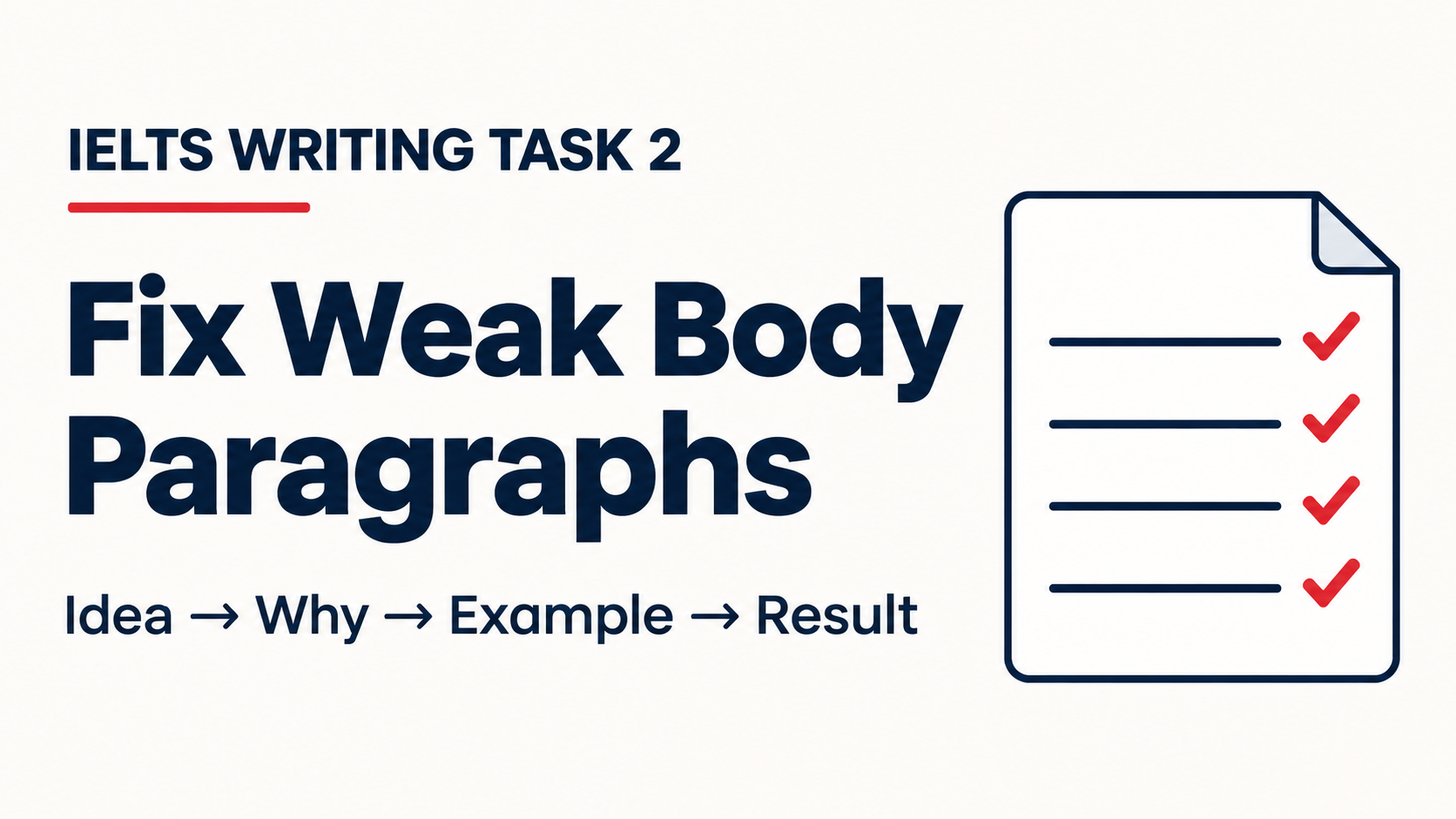
How to Fix Weak Body Paragraphs in IELTS Writing Task 2
Your IELTS body paragraph has three relevant ideas, but each gets only one sentence. By the end, the reader knows what you think but has little idea why. In my video, I use a question about whether the advantages of learning a foreign language in primary school outweigh the disadvantages...
Do You Need Expert Knowledge for IELTS Writing Task 2?
An IELTS essay question may ask about education, technology, work, or the environment. You might look at the topic and think: “I don’t know enough about this.” You don’t need expert knowledge. You need to answer the question with relevant ideas and explain them clearly. These practice examples show how to do that.
How Many Words Should You Write in IELTS Writing Task 2?
250 words is the minimum for IELTS Writing Task 2. But word count is only one part of your answer. You also need to answer the question, explain your ideas, and organize them clearly. My practical suggestion is to aim for around 260–270 words, then leave time to check your work.
Questions & Comments
Have an IELTS question about this? Ask below — comments are reviewed before they appear.
No comments yet — be the first to ask a question.