
Why You Understand IELTS Listening but Still Lose Marks
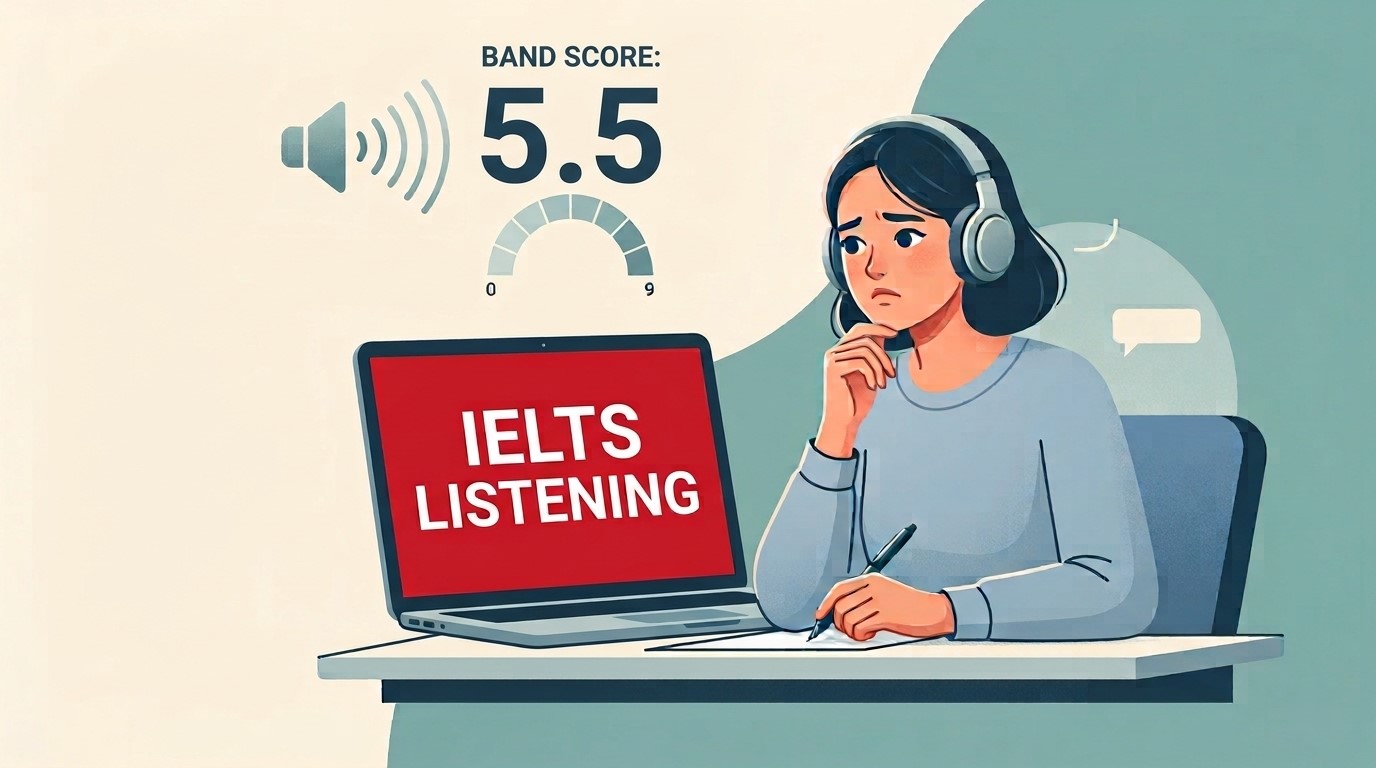
The problem may not be your general listening ability. You might be struggling with specific features of the IELTS Listening test. Let’s look at five common reasons.
1. You don’t recognise paraphrasing
This is one of the most important skills in IELTS Listening. The questions often use different words from the recording, even when they refer to exactly the same idea.
For example, a question might contain the word compulsory, but the speaker says mandatory. If you don’t recognise the connection, you might miss the answer even though you understand the speaker.
Here are three useful examples:
compulsory = mandatory (must be done)
substantial = considerable / sizeable (large or important in amount)
adequate = sufficient (enough)
Notice that you don’t always need to hear the exact word from the question. You need to recognise the same meaning expressed in a different way. When you check your answers, look at the words in the question and compare them with what the speaker actually said. Write down useful paraphrases you discover. Over time, you’ll become better at recognising them.
👉 Download this free PDF for more useful paraphrases
2. You don’t recognise connected speech
Sometimes, you know every word in a sentence but still struggle to understand it when you hear it. One reason is connected speech. In natural English, words don’t always sound separate. The final sound of one word may connect to the beginning of the next, and some sounds may become weaker or change.
For example, “next day” may sound like one connected phrase rather than two clearly separated words.
This is why simply learning more vocabulary doesn’t always solve listening problems. You also need to recognise familiar words when they are spoken naturally.
What can you do? When you get a Listening question wrong, replay the relevant part of the recording while reading the transcript, if one is available. Notice how the words sound when connected. Then listen again without looking at the transcript.
You can read more about this in my article on connected speech.
3. You miss changing answers
In IELTS Listening, speakers sometimes give one piece of information and then correct it. If you write the first answer too quickly, you may miss the correct one.
For example:
“The room number is 17. Oh, actually, it’s 70.”
The correct answer is 70, not 17.
This can happen with dates, prices, times, addresses, names, and other details. The speaker may change their mind, correct a mistake, or explain that the original information was wrong. Listen carefully for expressions such as actually, sorry, I mean and no, that’s not right. These can signal that the information is changing.
The important point is not to stop listening as soon as you hear something that fits the question. Keep listening until the speaker has finished giving the information.
4. You lose your place in the recording
This is particularly common in Section 4, where you listen to a lecture. The speaker continues talking while you read, think, and write, so it’s easy to fall behind.
Imagine you miss the answer to Question 32. You keep thinking about it while the speaker moves on to Question 33 and then Question 34. Suddenly, you’ve missed three answers instead of one.
One useful technique is to identify key words in the questions before the recording starts. Think of these as warning words that help you recognise when the speaker is discussing the relevant point.
For example, if a question asks about the main disadvantage of a particular method, underline main disadvantage and method. The speaker may not use those exact words, but you know what kind of information to listen for. As you listen, follow the questions in order. If you miss an answer, move to the next question immediately. You can return to the missed answer later if time allows.
5. You understand the answer but write it incorrectly
Sometimes, you hear the correct answer but lose the mark because of a small mistake. For example, you might write student instead of students, misspell a word, or write a word in the wrong form.
You also need to follow the word limit in the instructions. If the instruction says NO MORE THAN TWO WORDS, an answer containing three words will be incorrect, even if the meaning is right. When checking your answers, don’t just ask yourself whether you understood the recording. Check the actual words you wrote, including spelling, singular and plural forms, and the instructions for each question.
How to improve your Listening score
The next time you complete a practice test, don’t stop after checking how many answers you got right.
Go back to your mistakes and identify the reason for each one. Did you fail to recognise a paraphrase? Could you not recognise the words because of connected speech? Did the speaker change the answer? Did you lose your place? Or did you write the answer incorrectly?
These problems are different, so they need different solutions. The goal is not simply to complete more practice tests. It’s to understand why you’re losing marks and work on the specific skills you need to improve.
Ready to practise? Try a free IELTS Listening practice test on my website and use these tips to understand your mistakes.
Talk soon,
Iman
About the author

Teacher Iman
IELTS Specialist & Founder of IELTS TIME
- CELTA
- DELTA
- MA in English Language Teaching
- 15+ Years IELTS Teaching Experience
Not sure what is stopping your IELTS progress?
Take the free IELTS assessment and get your personal roadmap.
Related Articles
What I would do if I had to improve my IELTS Speaking in 30 days
If I had only 30 days to improve my IELTS Speaking, I wouldn't spend my time memorizing model answers or answering hundreds of random questions.
What Should You Actually Change When You Paraphrase IELTS Task 1?
You need to paraphrase the question in IELTS Writing Task 1, but you shouldn’t change every single word. When you replace every word with a synonym, your sentence can sound strange or unnatural.
19 Wrong Ideas About IELTS (and the Truth)
As an IELTS teacher, I hear these myths every week. Most are false, and believing them can cost you band points and months of study time.
Questions & Comments
Have an IELTS question about this? Ask below — comments are reviewed before they appear.
No comments yet — be the first to ask a question.