
Do You Know How to Start Your IELTS Writing Task 2 Essay?
Let’s look at how to avoid these mistakes.
1. Paraphrase the question naturally
Consider this question:
Some people believe that university education should be free for everyone. To what extent do you agree or disagree?
A weak paraphrase might be:
Some people think that university education should be free for all people.
This changes only a couple of words and does very little to rephrase the original statement.
One easy technique is to change the sentence structure. For example, you can sometimes turn an active reporting structure into a passive one:
Original: Some people believe that university education should be free for everyone.
Paraphrase: It is believed that university education should be free for everyone.
You can also use a different reporting verb:
Some people argue that university education should be free for everyone.
It is argued that university education should be free for everyone.
Another option is to express the same idea using different vocabulary and structure:
Some people argue that students should be able to attend university without paying tuition fees.
Notice that you don’t need to change every word. The aim is to express the same meaning naturally, not to find a synonym for each word.
How to practise: When you paraphrase a question, try changing the sentence structure first. For example, if the question begins with Some people believe that…, consider whether It is believed that… would work. Then look for one or two other natural ways to express the key idea.
2. Make your position clear
The second sentence should answer the question directly.
For the same question, you could write:
I largely agree with this view because it would give more students access to higher education, although governments would need to find a sustainable way to fund it.
This gives the reader your position and introduces the main reason behind it.
Compare that with:
This essay will discuss the advantages and disadvantages of free university education.
The second sentence doesn’t answer the question. The examiner shouldn’t have to guess whether you agree or disagree. Your position doesn’t have to be extreme. You can agree, disagree, or take a balanced position, provided your meaning is clear, and you maintain it throughout the essay.
3. Adapt your introduction to the question type
Not every Task 2 question asks you to do the same thing. Your introduction needs to reflect the actual task.
Agree or disagree
Question: Some people think children should start learning a foreign language at primary school rather than secondary school. To what extent do you agree or disagree?
Example introduction:
Some people believe that foreign language education should begin in primary school rather than secondary school. I agree with this view because younger children have more time to develop their language skills and can become familiar with a new language before their academic workload increases.
Notice that the second sentence states a clear position and gives reasons that can be developed in the body paragraphs.
Discuss both views and give your opinion
Question: Some people believe that employees should work from home, while others think they should work in an office. Discuss both views and give your own opinion.
Example introduction:
Some people favour remote working because it offers greater flexibility, while others believe that working in an office encourages collaboration. In my view, working from home is beneficial for many employees, although regular face-to-face interaction remains valuable for certain tasks.
This introduces both sides and makes the writer’s opinion clear.
Advantages and disadvantages
Question: More people are shopping online rather than in physical stores. Do the advantages outweigh the disadvantages?
Example introduction:
Online shopping has become increasingly common as consumers can purchase goods without visiting a physical store. I believe its advantages outweigh the disadvantages because it offers convenience and allows people to compare prices easily.
The key is to answer the specific question. Here, you need to say whether the advantages outweigh the disadvantages, not merely announce that the essay will discuss both.
4. Avoid these three common mistakes
Mistake 1: Using memorized openings
Phrases such as “Since the dawn of time” or “In this modern era” often add nothing to the introduction. Start directly with the topic instead.
Mistake 2: Making the introduction too long
You don’t need several sentences of general background before answering the question. Save your explanations and examples for the body paragraphs.
Mistake 3: Giving an unclear opinion
Avoid vague statements such as “There are both positive and negative sides to this issue” when the question asks whether you agree or disagree. Answer the question directly, then develop your reasoning in the body paragraphs.
5. Practise writing your own introduction
Try this question:
Some people believe that governments should spend more money on public transport than on building new roads. To what extent do you agree or disagree?
Write just two sentences:
Paraphrase the question naturally.
State your position and, if appropriate, briefly introduce your main reason.
Then check your work:
Have you kept the original meaning?
Is your position clear?
Have you avoided unnecessary background information?
Does the wording sound natural rather than memorised?
You can also use the free IELTS TIME Task 2 Planner to organize your position and main ideas before you start writing.
Remember: A strong introduction isn’t about using impressive vocabulary or complicated sentences. It’s about showing that you understand the question and know exactly how you’re going to answer it.
Talk soon,
Iman
About the author

Teacher Iman
IELTS Specialist & Founder of IELTS TIME
- CELTA
- DELTA
- MA in English Language Teaching
- 15+ Years IELTS Teaching Experience
Not sure what is stopping your IELTS progress?
Take the free IELTS assessment and get your personal roadmap.
Related Articles
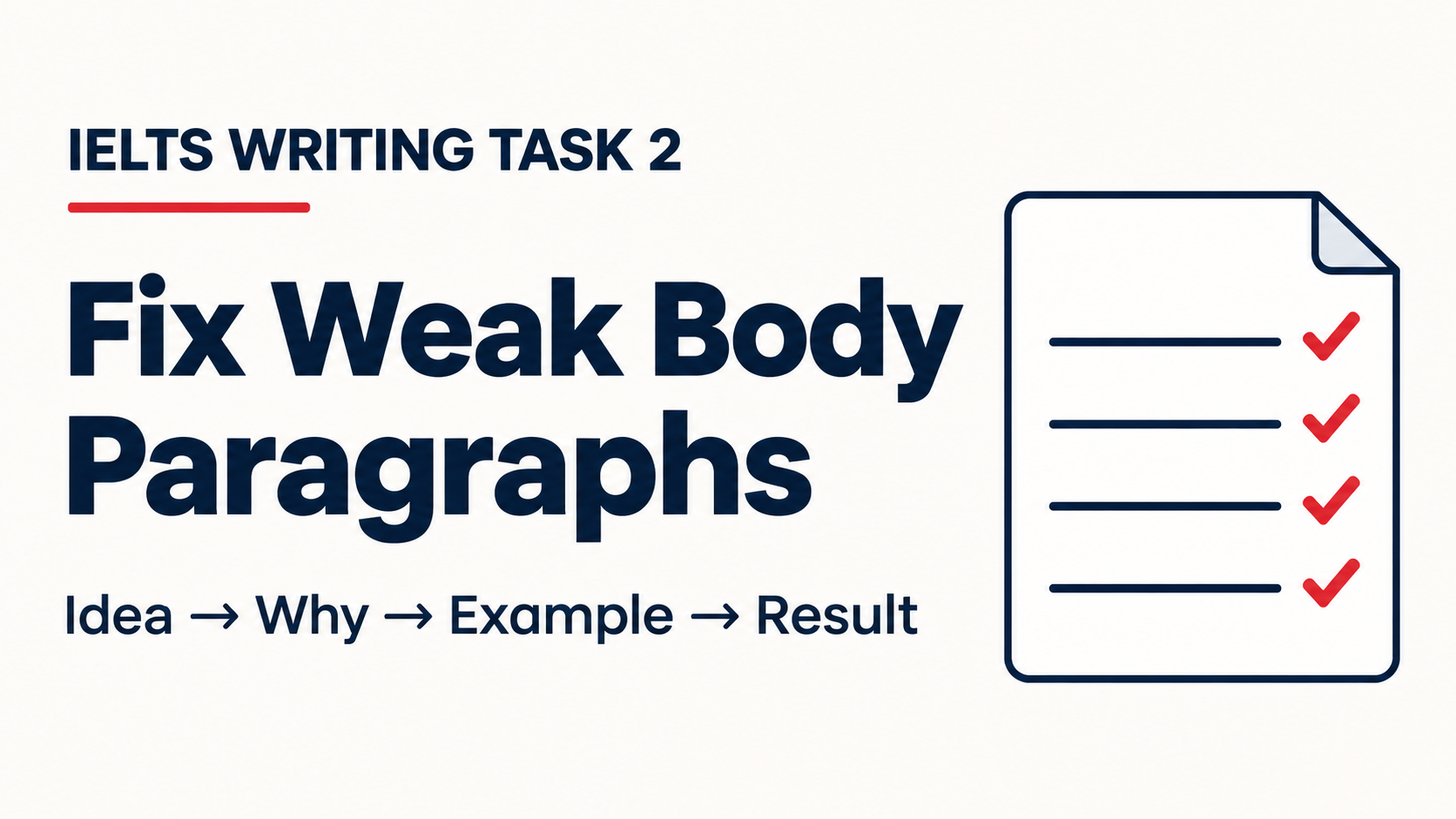
How to Fix Weak Body Paragraphs in IELTS Writing Task 2
Your IELTS body paragraph has three relevant ideas, but each gets only one sentence. By the end, the reader knows what you think but has little idea why. In my video, I use a question about whether the advantages of learning a foreign language in primary school outweigh the disadvantages...
Do You Need Expert Knowledge for IELTS Writing Task 2?
An IELTS essay question may ask about education, technology, work, or the environment. You might look at the topic and think: “I don’t know enough about this.” You don’t need expert knowledge. You need to answer the question with relevant ideas and explain them clearly. These practice examples show how to do that.
How Many Words Should You Write in IELTS Writing Task 2?
250 words is the minimum for IELTS Writing Task 2. But word count is only one part of your answer. You also need to answer the question, explain your ideas, and organize them clearly. My practical suggestion is to aim for around 260–270 words, then leave time to check your work.
Questions & Comments
Have an IELTS question about this? Ask below — comments are reviewed before they appear.
No comments yet — be the first to ask a question.