
False or Not Given in IELTS Reading? Learn the Difference
You find the right paragraph. You recognise the words. But you still cannot decide: False or Not Given?
Ask yourself: Does the passage prove the statement wrong, or is some information missing?
Let’s practise with official IELTS questions, then use a short routine you can try tonight.
First, try three real IELTS questions
Open the official IELTS Academic Reading sample tasks.
Read “The life and work of Marie Curie” on page 12 and answer Questions 1–3 on page 13. These are official IELTS sample questions.
Before checking the answers, write a short reason for each choice.
Question 1: False needs evidence
The first statement says Pierre shared both of Marie’s Nobel awards.
The passage explains that she shared one award but received the other alone. This proves the statement wrong.
Answer: False.
What to practise: circle both in the question. It is not enough to find the names and awards—you need to check whether Pierre shared both.
Question 2: Not Given means a detail is missing
The second statement concerns whether Marie’s interest in science began during childhood.
The passage describes her childhood memory and school success. It does not tell us when she became interested in science.
Answer: Not Given.
School success does not prove an interest in science. It does not prove a lack of interest either.
What to practise: identify the missing detail: when her interest began.
Question 3: True can use different wording
The third statement links Marie’s university attendance to financial help from her sister.
The passage describes their arrangement: Marie supported her sister’s studies, and her sister later returned that support.
Answer: True.
What to practise: follow the connection between the sisters’ agreement and what happened later. Read across sentences, rather than looking for one matching phrase.
A simple check for every answer
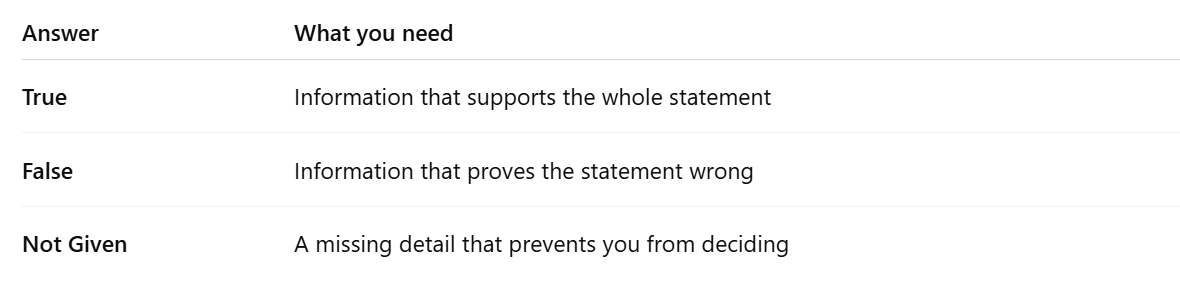
Don’t choose False simply because you cannot prove True. You need evidence that the statement is wrong.
For Not Given, try completing this sentence:
“The passage tells me ________, but it doesn’t tell me ________.”
This helps you identify exactly what is missing.
Watch the words that change the meaning
Pay attention to words such as:
all, some, both, only
always, sometimes, never
before, after, first
more, less, most
Underline them in the question, then check them against the passage.
These words do not automatically make an answer False. They tell you which details need careful checking.
Also, ask whether the question adds something: a reason, a date, a comparison or someone’s opinion. Finding the topic does not mean every detail in the statement is covered.
What should you do when time is running out?
On test day, if you have found the relevant section and checked carefully but the information needed to decide is still missing, choose Not Given and move on.
However, not finding the right section is different from finding that a detail is missing. If you are still unsure, make your best guess and continue. Don’t spend several minutes on one question.
Try this 15-minute practice routine tonight
Minutes 1–5: Answer three questions
Use the Marie Curie exercise linked above. Read the passage and choose your answers without looking at the key.
Minutes 6–10: Explain your choices
For each True or False answer, underline the evidence. For each Not Given answer, write down the missing information.
Minutes 11–15: Review your mistakes
Check the official answers on page 14. For each mistake, ask:
Did I misunderstand a sentence?
Did I miss a word such as both or only?
Did I assume something the passage did not say?
Did I recognise the words but miss the meaning?
If you misunderstood a sentence, explain it in simple English. If an unfamiliar phrase caused the problem, record the phrase and review it tomorrow.
Test techniques help, but you still need to understand the text. Make reading in English a daily habit and learn useful vocabulary from what you read.
Continue practising with me
In my Reading preparation video, I explain how to build your understanding and apply it to IELTS questions at home.
👉 Watch: How to prepare for IELTS Reading at home
In your next practice session, aim to explain why an answer is correct—not just choose a label.
About the author

Teacher Iman
IELTS Specialist & Founder of IELTS TIME
- CELTA
- DELTA
- MA in English Language Teaching
- 15+ Years IELTS Teaching Experience
Not sure what is stopping your IELTS progress?
Take the free IELTS assessment and get your personal roadmap.
Related Articles
How to Fix Weak Body Paragraphs in IELTS Writing Task 2
Your IELTS body paragraph has three relevant ideas, but each gets only one sentence. By the end, the reader knows what you think but has little idea why. In my video, I use a question about whether the advantages of learning a foreign language in primary school outweigh the disadvantages...
Do You Need Expert Knowledge for IELTS Writing Task 2?
An IELTS essay question may ask about education, technology, work, or the environment. You might look at the topic and think: “I don’t know enough about this.” You don’t need expert knowledge. You need to answer the question with relevant ideas and explain them clearly. These practice examples show how to do that.
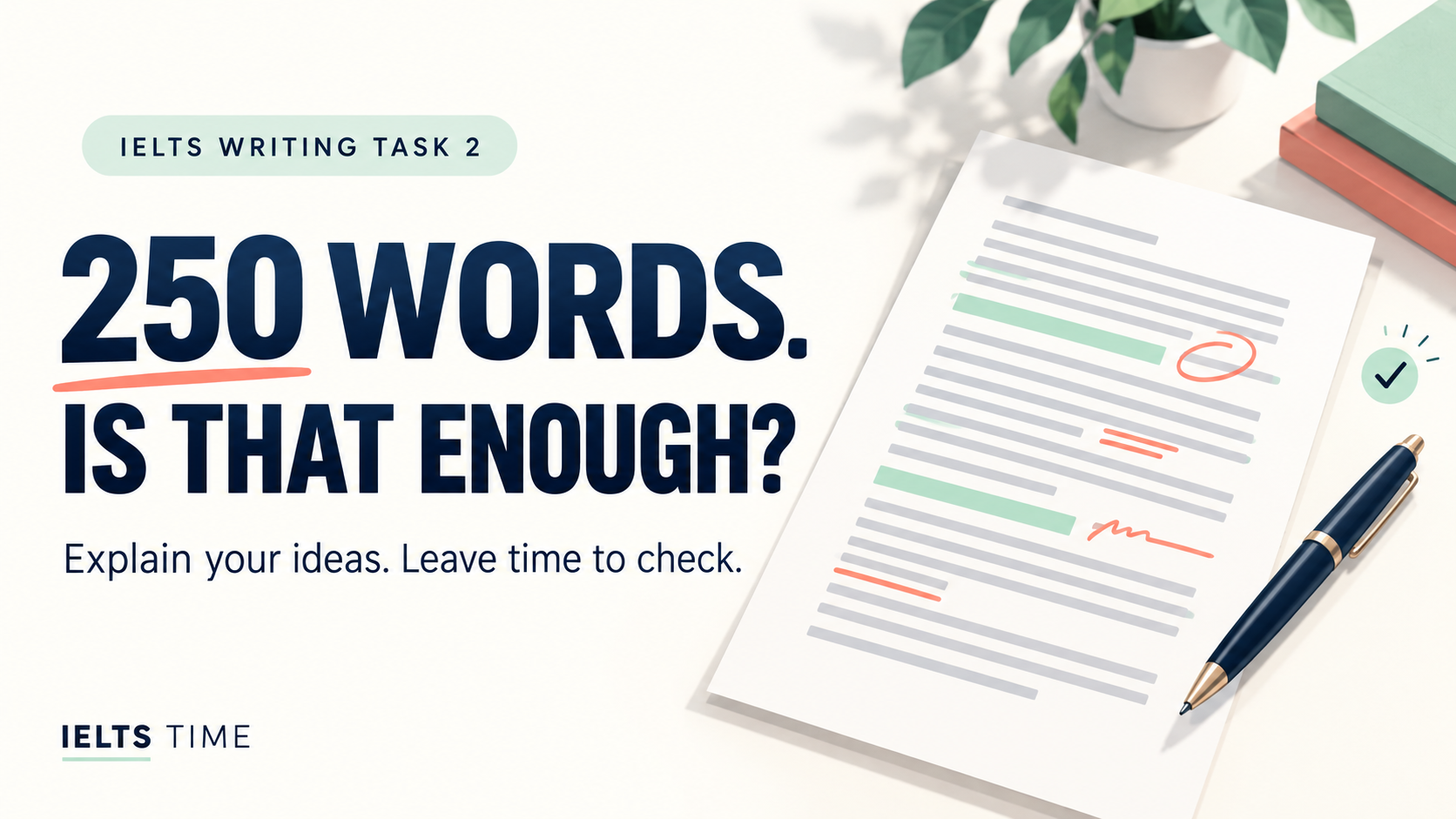
How Many Words Should You Write in IELTS Writing Task 2?
250 words is the minimum for IELTS Writing Task 2. But word count is only one part of your answer. You also need to answer the question, explain your ideas, and organize them clearly. My practical suggestion is to aim for around 260–270 words, then leave time to check your work.
Questions & Comments
Have an IELTS question about this? Ask below — comments are reviewed before they appear.
No comments yet — be the first to ask a question.