
If You Keep Getting Band 6 in Speaking, Read This
Sep 30, 2026
You practise.
You learn new vocabulary.
You watch videos.
You answer hundreds of IELTS questions.
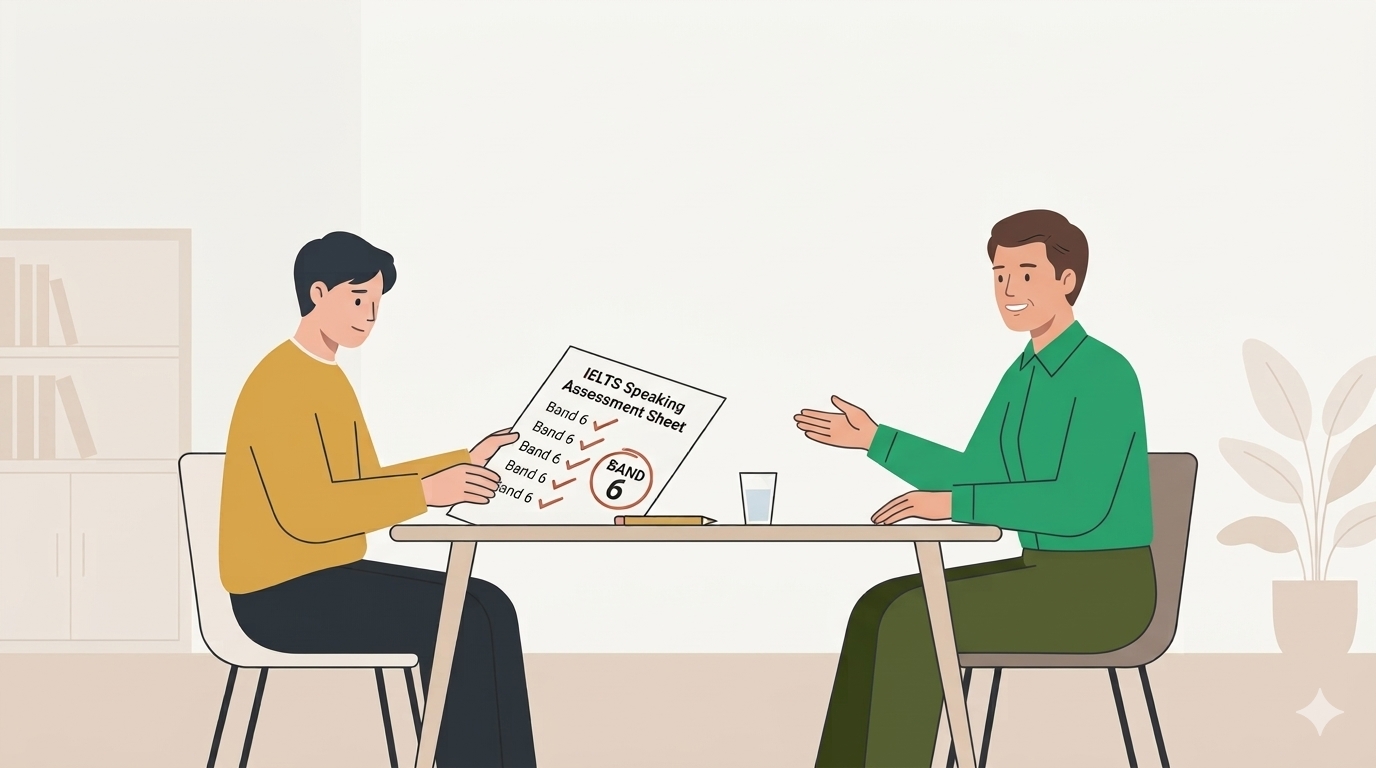
And then you get your result: Speaking: 6.0
So you try again.
And get 6.0 again.
If this sounds familiar, there may be a simple reason:
You’re practising speaking, but you’re not necessarily practising the things you need to change.
After years of teaching IELTS, these are some of the things I would look at if a student was stuck at Band 6 and wanted to move towards Band 7.
1. You rely on the same few linking words
Listen carefully to your own speaking.
How often do you say:
“And…”
“But…”
“Because…”
“Also…”
There’s nothing wrong with these words. They’re useful and completely natural. The problem is when they’re basically the only way you connect your ideas. To move towards Band 7, you need to show that you can connect and organise your ideas in different ways.
For example:
“I enjoy living there because it’s quite peaceful. On top of that, there are plenty of things to do. Having said that, it can get quite crowded at weekends.”
You don’t need to force sophisticated connectors into every sentence. But you should have a wider range available to you, such as:
on top of that
as a result
having said that
on the other hand
in particular
for example
in fact
generally speaking
the main reason is that…
The important thing is variety and natural use, not collecting a list of impressive linking phrases.
2. You pause too much — especially with “umm” and “ah”
This is probably one of the biggest differences between a student who sounds comfortable and one who sounds hesitant. Listen to yourself answering a question.
How often do you say:
“Umm…”
“Ah…”
“Umm, I think…”
“Ah… actually…”
A few hesitations are completely normal. Nobody speaks perfectly fluently all the time. The problem is when these pauses happen so often that they interrupt your speech. And unfortunately, there isn’t a magic phrase that will fix this.
You need to practise. A lot.
Record yourself answering questions.
Listen back.
Notice your hesitation patterns.
Then answer the same question again.
And again.
Over time, you want to become better at thinking while you are speaking, rather than stopping completely while you search for your next sentence. But there’s another useful technique.
You can use natural phrases to give yourself a little thinking time:
“Well, let me think about that.”
“That’s an interesting question.”
“I’ve never really thought about that before.”
“I’d say…”
“It depends, really.”
These are much better than repeatedly saying “umm… ah…”. Just don’t memorise one phrase and use it before every answer. That will quickly become another habit.
3. Your vocabulary may be correct — but too basic
You don’t need to use complicated words all the time. But if most of your vocabulary is very basic, it can be difficult to demonstrate a wider lexical range. This is where collocations and less common vocabulary become important.
For example, instead of always saying:
“It has a bad effect on people.”
You could say:
“It can have a negative impact on people’s health.”
Or instead of:
“It makes people very tired.”
You might say:
“It can leave people feeling exhausted.”
The important thing is not simply learning the individual words negative, impact or exhausted.
Learn useful combinations:
have a negative impact on
play a significant role in
take something into consideration
raise awareness of
be exposed to
have access to
a major contributing factor
a growing concern
This gives you language that you can actually use when you speak. Don’t learn vocabulary just because it looks advanced on a word list. Learn language that you can imagine yourself using. If you want to work specifically on this, I've put together a Speaking Vocabulary Toolkit with useful topic-based vocabulary, collocations and phrases that you can actually use in the test. You can get it from my IELTS TIME shop or download a free sample to see what's inside.
4. You make too many basic grammar mistakes
You don’t need perfect grammar to get Band 7. You will make mistakes. That’s normal. The problem is when basic errors happen frequently.
For example:
“He go to work every day.”
“People is becoming more dependent on technology.”
“Yesterday I go to the cinema.”
If mistakes like these happen regularly, they can hold your speaking back even if you occasionally produce more complex sentences. So one of the best things you can do is identify your own recurring grammar mistakes. Not every grammar mistake in English.
Your mistakes.
Maybe you regularly forget the third-person -s.
Maybe you confuse past and present.
Maybe your articles are often missing.
Maybe you have problems with countable and uncountable nouns.
Find your patterns and work on those. And then there’s another part of grammar that students sometimes overlook: variety. Don’t speak only in short, simple sentences.
For example:
“I like my hometown. It is quiet. There are many parks. I enjoy living there.”
Try combining different structures:
“I enjoy living in my hometown because it’s relatively quiet, and although there aren’t many entertainment options, there are plenty of parks and open spaces.”
You want to be comfortable using both simple structures and longer, more complex ones.
5. Your pronunciation is making your English harder to follow
This is another area that students sometimes ignore. They practise speaking for hours, but they don’t really listen to how they’re speaking. Pronunciation isn’t just about whether you pronounce individual words correctly.
You also need to think about: word stress
PREsent vs preSENT
sentence stress
Which words are important in the sentence?
chunking
How do you group words together when you speak?
Compare:
“I / really enjoy / living in my hometown / because it’s / quite peaceful.”
with a more natural flow where the words are grouped into meaningful chunks. Good chunking makes speech easier to follow. And sentence stress helps your listener understand which information is important. This is why simply practising more isn’t always enough. If you practise the same pronunciation habits again and again, you may just become very good at repeating them. Practise speaking — but also listen to yourself.
So what should you do?
If you’ve been stuck at Band 6, don’t simply decide:
“I need to practise more.”
Ask yourself:
What exactly am I practising?
For the next few weeks, try recording yourself regularly.
Choose a Speaking question and answer it for a minute or two.
Then listen back.
Don’t worry about your score.
Look for specific things:
Fluency
How often did I say umm or ah?
Did I have long unnatural pauses?
Could I keep my ideas moving?
Linking
Did I use the same connectors repeatedly?
Could I connect ideas in different ways?
Vocabulary
Did I use useful collocations?
Did I rely on the same basic words?
Grammar
Did I make basic errors?
Did I use a mixture of simple and more complex structures?
Pronunciation
Was my speech clear?
Did I stress important words?
Did I group words into natural chunks?
Then do something very important:
Answer the same question again.
This time, focus on one or two things you noticed.
That’s much more useful than simply answering another 20 questions.
One final thing
Don’t become obsessed with “Band 7 vocabulary” or memorising complicated phrases. The goal isn’t to sound impressive. The goal is to become a more flexible, accurate and understandable speaker. If you’re stuck at Band 6, you may not need to learn hundreds of new words or practise thousands of new questions. You may need to take the English you already know and become better at using it under pressure.
So the next time you practise, don’t just ask:
“Did I answer the question?”
Ask:
“What did my English actually sound like?”
That’s where you may find the things that are keeping you at Band 6.
Not sure what you need to work on?
If you keep getting Band 6 and you’re not sure exactly what’s holding you back, you may not need more practice. You may need a clear idea of what’s actually stopping you from improving. In a 1-to-1 Session, I will look at your IELTS Speaking and identify the areas you need to work on, so you can stop guessing and start practising with a clear direction. It could save you a lot of time, money, and frustration.
Talk soon,
Iman
About the author

Teacher Iman
IELTS Specialist & Founder of IELTS TIME
- CELTA
- DELTA
- MA in English Language Teaching
- 15+ Years IELTS Teaching Experience
Not sure what is stopping your IELTS progress?
Take the free IELTS assessment and get your personal roadmap.
Related Articles

Why Your Speaking Answers Are Too Short
One of the most common problems I see in IELTS Speaking is very short answers. The examiner asks a question, the student answers it in one sentence, and then… nothing.
IELTS Writing Task 1: How to Improve Cohesion and Coherence
Good Cohesion and Coherence in IELTS Writing Task 1 is about more than using linking words. Learn simple ways to organise information, make clear comparisons, and create stronger connections between your sentences.
Is Connected Speech Important for Your IELTS Speaking Score?
The short answer is yes, connected speech is important. But let's be precise. Connected speech is not a separate IELTS scoring criterion. IELTS Speaking is assessed using four criteria: -Fluency and Coherence -Lexical Resource -Grammatical Range and Accuracy -Pronunciation
Questions & Comments
Have an IELTS question about this? Ask below — comments are reviewed before they appear.
No comments yet — be the first to ask a question.